
How different is mathematics?
Really just musing in this one

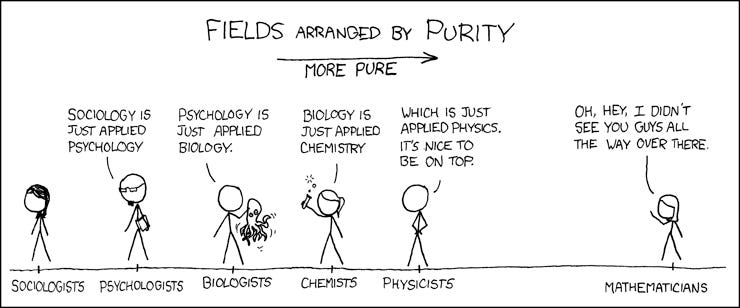
When I wrote Wednesday’s post about angle notation, I was heading towards the idea that there is something essentially different about the way notation is used in mathematics. Cathy Kessel (whose excellent occasional blog is here) sent me an astute email saying, “It sounds as if you’re thinking that mathematics is different in kind. I think about it as different in degree.”
Notation, notation, notation
I decided Cathy was right. Trying to distinguish a difference in kind leads you down a cul-de-sac of trying to figure out where to draw a distinguishing line; you’ll end up discovering that you are just trying to draw a line in a continuum. For example, where do you put chemical equations? Cathy quoted Moses and Cobb, in Radical Equations, following Quine in suggesting that mathematical symbolism is regimented ordinary language, which makes it “feasible to apply experiential learning to teach algebra to middle school students.” Algebra is not a magic kingdom you have to be transported into; it is a way of talking that you can relate to concrete experience.1
Still, I think the linguistic density of mathematical notation is a distinguishing feature.
Progressions and compression
If a student studies biology one year, forgets everything over the summer, and studies physics the following year, they are probably going to be OK in physics.2 It doesn’t work that way in mathematics, as any math teacher knows. Mathematics is built on progressions. There’s a long march from whole number arithmetic to fractions to ratios to proportional relationships to linear functions. If you get lost along the way then it’s hard to catch up. Schemas of understanding are many layers deep. Fractions start life as a complex schema involving an understanding of division, unitizing, and composing; by the time you are solving equations with rational coefficients they should just be numbers you can operate with like any other. If they aren’t, you are stuck with an overcrowded working memory as you try to solve equations. Once you move from solving 3x = 18 to considering y = mx + b you have done another round or two of compression, with schemas recursively collapsing to nodes in the network of knowledge. The arc from adding numerical fractions in grade 3 to adding algebraic fractions in high school is long; students who don’t see it are doomed to repetition (and curricula that don’t support it are complicit). This is perhaps another matter of degree; there are, obviously, progressions in other subjects. But the damage is limited if you fail at one and start another. In mathematics there really isn’t another one to start for a long time.
The fusion of concepts and procedures
In this post I talked about this fusion in the simple addition fact 8 + 5 = 13. The standard algorithm lives on the substrate of the base ten system; the carried one is a rebundling of base ten units. True, you can learn to execute it without recognizing that substrate; Skemp called this “rules without reasons,” and raised the possibility that there were two subjects being taught under the name mathematics, instrumental mathematics (rules without reasons) and relational mathematics, “knowing both what to do and why.” Without getting in a debate about the relative merits, one can make the observation that in relational mathematics concepts and procedures are tightly woven together. We saw this with the standard algorithm in My Abacus and with the quadratic formula in Beautiful Expressions.
I think this fusion results from the deeply procedural nature of mathematics; it’s hard to imagine teaching procedural history or procedural biology, or what that would even look like.
Abstraction is the content
Children are born with the ability to see the difference between sets with cardinality one, two, or three, and with certain geometric sensibilities. Everything else they learn in mathematics is an abstraction. In other fields you are studying concrete objects from which you draw abstractions. In mathematics you have to create the concrete objects; collections of things to count, the faux concrete contexts of word problems. This is why reification becomes such an important process in mathematics. Everything is abstract and needs to be made real.
I’m not sure about any of this
These really are just mathematical musings. I’d love to hear what you think. Are there other distinctive features of mathematics? Are all these just differences of degree? Is mathematics really as distinctive as I think it is? And do these differences have implications for how we teach the subject? Let me know in the comments.
Cathy also pointed me to cladograms and Feynman diagrams as examples that carry the same density of information as labelled geometric figures. I do think there is something special in the way that angle notation almost draws the figure for you.
Of course they might forget all that the following year, but that’s a separate problem.
I do think there is some difference in kind, not centered in language but stemming from the fact that the basis for validity in mathematics is logic rather than evidence/data, as well as the expectation that mathematics has complete logical fidelity. Logical fidelity is part of what makes mathematics so useful for scientific application. The language becomes a hybrid of human language and (what we can now think of as) computer code.
Great article. I'm into learning languages, and I often look at math as similar to learning a language.
Both involve building vocabulary, mastering grammar-like rules, and gaining fluency through sufficient practice. Symbols and notation act as a dense "regimented ordinary language," allowing compact expression of complex ideas, much like mastering idioms or syntax in French or Spanish. Language has grammar rules fused with cultural nuance, and you abstract from concrete speech. That's similar to math's tight fusion of concepts and procedures, plus its abstract nature.
However, math has stricter progressions vs learning a language. For instance, learning German lets you begin with simple nominative-case sentences like “Der Mann isst Brot” right away and start communicating. Truly internalizing the full case system—accusative, dative, and genitive—requires sufficient repetitive practice (like in math) with declensions, articles, and adjective endings until they become automatic through drills and other practice. But you don't have to master accusative before dative or genitive, or dative or genitive before accusative and you can debate where to start after nominative regardless. There are also rules on adjectives to learn, along with tons of vocabulary and learning to speak it with automaticity.
Elementary math demands stricter sequencing: students must master addition with regrouping, subtraction, place value, multiplication, and long division through sufficient practice until those procedures are fluent and automatic, because they form the non-negotiable procedural and conceptual foundation for fractions, ratios, proportions, and algebra; a weak grasp at any step creates lasting roadblocks.