
What is procedural fluency?
This one should be easy, right?


Let’s start with a couple of standard definitions. Here is the 2001 definition from Adding It Up:
Procedural fluency refers to knowledge of procedures, knowledge of when and how to use them appropriately, and skill in performing them flexibly, accurately, and efficiently.
And here is the definition from the NCTM position statement Procedural Fluency in Mathematics (2014, reaffirmed 2023):
Procedural fluency is the ability to apply procedures efficiently, flexibly, and accurately; to transfer procedures to different problems and contexts; to build or modify procedures from other procedures; and to recognize when one strategy or procedure is more appropriate to apply than another.
I think these are both pretty good. They both describe something more than rote procedure—mechanically performing steps without thinking about them. They both include accuracy, the sine qua non of fluency. They both mention flexibility, efficiency, and appropriateness, which I will talk about more below. Neither makes explicit mention of something that comes up a lot in debates—quick recall of math facts—although one could make the case that this is implicit. More on that below as well.
Flexibility, Efficiency, and Appropriateness
When we were writing the Common Core and people in the reform camp were uncomfortable that we required fluency in the standard algorithms,1 they would say, “but fluency includes flexibility, right?” I got the impression that flexibility, as a property of fluency, was being interpreted as flexibility about which procedures count. Maybe the term “standard algorithm,” interpreted flexibly, could include something like the expanded algorithm where you add the 10s and 1s separately and then add the results.2 There are many procedures that are appropriate developmental stages in the journey towards fluency but that do not count as fluent.
Star & Seifert (2006) describe a different sort of flexibility in the solving of linear equations.
The less flexible solver always uses the same method: expand, collect, move to the other side, divide. The flexible solver uses the same toolbox, but notices that sometimes it is more efficient to use the tools in a different order, for example by dividing first, or by collecting bracketed terms. The authors refer to this as invention of procedures, but are clear about what they do not mean. Invention happens at the “transformation level, rather than at the whole procedure level,” and “is not intended to capture the idiosyncratic, inefficient, and sometimes strange solution methods that many students discover and use.”
In an earlier paper, Star (2005) points out that definitions of conceptual understanding and procedural fluency can smuggle in a distinction of quality: conceptual understanding is rich in connections, whereas procedural fluency is superficial. He proposes another axis—distinction of type—and argues for more research on the top right corner of this table.
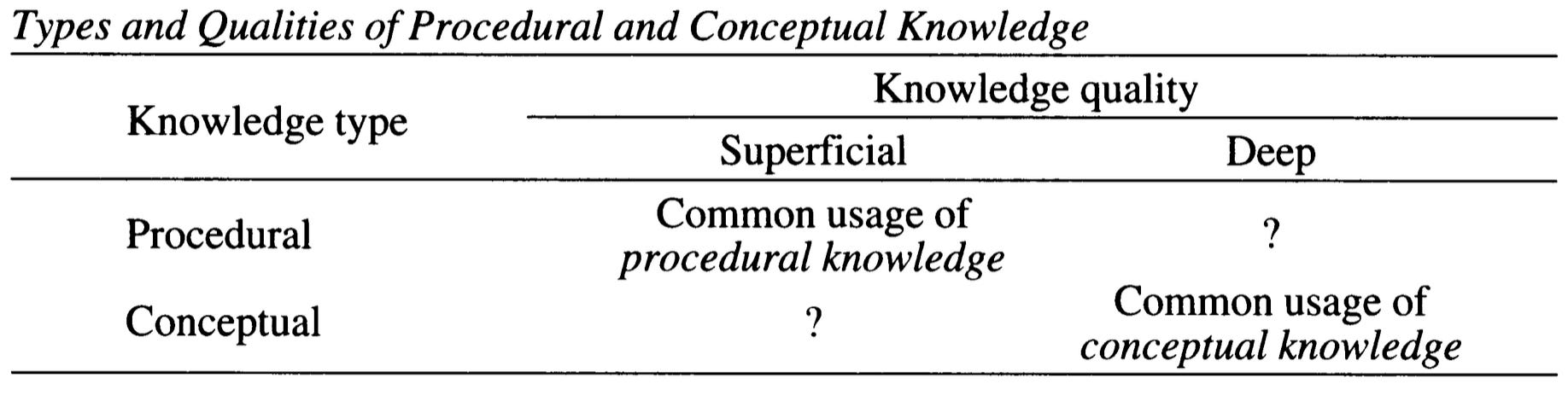
The flexibility that Star & Seifert talk about is an example of deep procedural knowledge. I’m going to call it adaptive efficiency because it allows students to adapt their repertoire of procedural moves to arrive at a more efficient solution.3 This avoids the ambiguity in the word flexibility, and it captures the notion of appropriateness—the appropriate procedure will be the adaptively efficient one.
Fact fluency
This is knowing your addition facts and times tables off by heart. In the literature it is often treated separately from procedural fluency, and that makes sense from a scholarly point of view: facts are not procedures. But I think in the popular mind the two are lumped together, so I’m going to treat it alongside procedural fluency.
The seminal study is Geary’s (2011) longitudinal study, which tracked a cohort of students from grades 1–5. He found that first-graders’ use of direct fact retrieval to solve simple addition problems, rather than strategies like counting on,4 predicted faster growth in math achievement through fifth grade, even after controlling for intelligence, working memory, processing speed, and other early math skills (counting knowledge, number-line accuracy, and decomposition strategies).
The National Mathematics Advisory Panel (of which Geary was a member) says in the First Things First section (p. 11) that
Use should be made of what is clearly known from rigorous research about how children learn, especially by recognizing a) the advantages for children in having a strong start; b) the mutually reinforcing benefits of conceptual understanding, procedural fluency, and automatic (i.e., quick and effortless) recall of facts;5 and c) that effort, not just inherent talent, counts in mathematical achievement. [Emphasis added.]
I think there is pretty broad consensus, although not universal, that quick and effortless recall of facts is important. Where the debate gets heated is how to achieve that, and timed tests are a particular flash point. Jo Boaler (2014) argues against them, citing classroom examples of students experiencing anxiety around tests. One paper she cites caught my attention for its working memory angle: Ramirez et al. (2013)—a one-on-one assessment of first- and second-graders, not a classroom study and not about timed tests—finds a relation between math anxiety and reduced math performance, but only in students with high working memory. They hypothesize that math anxiety is using up the room in working memory that fluency frees, and the kids with high working memory have the most to lose.
At the other end of the debate, we have the IES practice guide by Gersten et al. (2009), Assisting Students Struggling with Mathematics: Response to Intervention for Elementary and Middle Schools,6 which I cited in The right tool for the job. The guide recommends explicit instruction (including timed exercises) for struggling students but, as I noted then, limits the recommendation to struggling students (Tier 2 and Tier 3): “the guide does not make recommendations for general classroom mathematics instruction” (p. 5).
Back on the no-timed-tests side of the debate, there is substantial literature arguing that fact fluency is best built through strategy-based games rather than timed drill, with speed as a downstream consequence. Bay-Williams & Kling’s Math Fact Fluency is a standard reference for this; I haven’t had time to look at it.
Fortunately, I do not have to resolve this game of ping pong here. My main takeaway is that students should acquire quick and effortless recall of math facts, whatever the instructional route taken.
The speed trap
The argument about speed of recall often gets mixed in with the argument about speed of execution for procedures generally. Rather than dig into the research here, I’m going to talk about Dan Willingham’s article Is It True That Some People Just Can’t Do Math?, which makes recommendations. Willingham is a cognitive psychologist at the University of Virginia who writes a regular column for American Educator applying cognitive science to classroom practice. He is a reasoned voice in an area which often gets overheated by partisan overreach. The article is a good read, covering automatic recall, procedural knowledge, and conceptual knowledge.
In teaching procedural and factual knowledge, ensure that students get to automaticity. Explain to students that automaticity with procedures and facts is important because it frees their minds to think about concepts. For automaticity with procedural knowledge, ensure that students are fluent with the standard algorithms. This requires some memorization and ample practice.
There’s that word automaticity again, which could be taken to mean speed in executing procedures. But earlier Willingham says “retrieval must be automatic (i.e., rapid and virtually attention free).” So automaticity means speedy retrieval, not speedy execution. For math facts, these are more or less the same thing: someone says 7×8, your brain says 56. Procedures are different from facts: even a fluent solver should be monitoring where they are in the procedure; think of Star & Seifert’s adaptive use of operations. You want the operations to be available automatically. What automaticity at the operation level buys is the working memory to do that monitoring smoothly. So rather than talking about rapid execution, I’m going to talk about smooth execution—what it looks like when the embedded retrievals are automatic. Someone who is fluent in a language is relying on automatic retrieval from long-term memory, but we don’t equate fluency of language with speaking quickly; we equate it with speaking smoothly.
So the final piece of my definition is smooth execution of procedures. I’m not dodging the speed question here: the speed that matters cognitively is speed of retrieval—that is where working memory gets freed. Speed of execution may be a consequence, but it’s not the lever. As for how you get speed of retrieval, that’s an argument for another day. My goal here is to name what it looks like when you do.
My definition
Let me explain what I am trying to do here. I have my own perspective as a mathematician interested in education; I’ve looked at some of the research; and I am mindful of popular conceptions. What I’m going for is something that (a) makes sense to me, (b) is aligned with the research, (c) speaks to the lay perspective, and, for bonus points, fits in working memory. Here is my definition, rolling appropriateness, Star & Seifert’s notion of flexibility, and NCTM’s language about modifying procedures into adaptive efficiency; naming smooth execution as a result of automatic retrieval; pulling in recall as a companion skill; and adding a clause about the functional result of the construct: freeing up working memory.
Procedural fluency is the accurate, adaptively efficient, and smoothly executed command of mathematical procedures. Together with quick and effortless recall of facts, it frees working memory for solving harder problems and learning concepts.
Phew.
Edited 5/29: revised the Boaler sentence to refer to “classroom examples of students experiencing anxiety around tests”; rewrote the Ramirez et al. passage to clarify the study design and the reason for citing it; added a footnote pointing to the 2021 WWC update of the Gersten et al. guide. Thanks to Todd Truitt and Cathy Kessel.
Here are the Common Core fluency standards. The ones that specifically require fluency with the standard algorithm are 4.NBT.B.4, 5.NBT.B.5, 6.NS.B.2, and 6.NS.B.3.
K.OA.A.5 Fluently add and subtract within 5.
1.OA.C.6 Add and subtract within 20, demonstrating fluency for addition and subtraction within 10.
2.OA.B.2 Fluently add and subtract within 20 using mental strategies. By end of Grade 2, know from memory all sums of two one-digit numbers.
2.NBT.B.5 Fluently add and subtract within 100 using strategies based on place value, properties of operations, and/or the relationship between addition and subtraction.
3.OA.C.7 Fluently multiply and divide within 100. By the end of Grade 3, know from memory all products of two one-digit numbers.
3.NBT.A.2 Fluently add and subtract within 1000 using strategies and algorithms based on place value, properties of operations, and/or the relationship between addition and subtraction.
4.NBT.B.4 Fluently add and subtract multi-digit whole numbers using the standard algorithm.
5.NBT.B.5 Fluently multiply multi-digit whole numbers using the standard algorithm.
6.NS.B.2 Fluently divide multi-digit numbers using the standard algorithm.
6.NS.B.3 Fluently add, subtract, multiply, and divide multi-digit decimals using the standard algorithm for each operation.
Nope. That’s a good lead-in, because it uses the base-ten structure, but it’s not the standard algorithm.
For example, not using the standard algorithm to subtract 999 from 1023.
E.g.: What’s 5 + 3? 5, 6, 7, 8 (keeping track with fingers).
As someone who had to adjudicate the language used in the writing of the Common Core, I can imagine the amount of time the panel spent arguing about “automatic” vs “quick and effortless” before deciding to use both, and then arguing about which one to put in parentheses.
I like this definition. The key for me is that fluency frees up working memory to learn more complex math. I also think that definition can help us think about exactly what students need fluency with.
An example: one reason multiplication fact fluency is important is that it frees up space to think about a tougher problem like 2x = 10. This helps me focus on which multiplication facts are most important. I've heard multiple prominent people in math education talk about how they're not totally fluent with 8x7 = 56, so fact fluency must not be very important. That misses the point: all of those people are certainly fluent in 2x5 = 10. I emphasize facts to 5, plus 10s and 11s, first in my class because having that strong base gives me a lot of examples to use to teach ax = b, and it's obvious observing students learn something like equation solving whether or not fluency is a barrier. I don't use 8x = 56 as an example early on in equation solving for that reason.
But then the dominos continue: I want students to be fluent in equations of the form ax = b, so when they get to ax + b = c, they have that automaticity to lean on (plus x + a = b, plus the flexibility to solve a + x = b, b = a + x, etc).
This also helps to narrow down where fluency might be a bit less important. I don't need students to know how to do 4 digit by 2 digit long division with automaticity, it's not a prominent component skill for future learning. I still think it's worth learning, but the goal is different.
All of that requires a lot of content knowledge. We have to know where students have been and where they're going to make good decisions about fluency.
I really appreciate the distinction of “smooth” versus “speed” because sometimes speed can work against fluency with procedures if it leads to more errors. I would think “smooth” incorporates both the quick recall you refer to and the ability to execute accurately which may or may not be fast.
The other thing I’m sitting with is the examples of flexible problem solvers. I encounter this all the time in my 10th grade class where some students are very comfortable completing a procedure in the way that they are used to or were taught but the foundation is not strong enough to be able to pivot flexibly to using a different approach that could be more efficient. I’ve really struggled with how to build that capacity in students. It seems that modeling more flexible methods only translates to the specific contexts of those problems and doesn’t build flexibility overall. My guess is that it comes from deeper fluency with facts and procedures overall but finding the time and capacity to build that back up in 10th grade is challenging. It would be really helpful to have a better understanding of where that flexibility comes from.
Great piece as always! I can’t wait to look more into the other sources you linked.