
My abacus
The base ten system made manifest

When I stepped down as CEO of Illustrative Mathematics, the board gave me this.
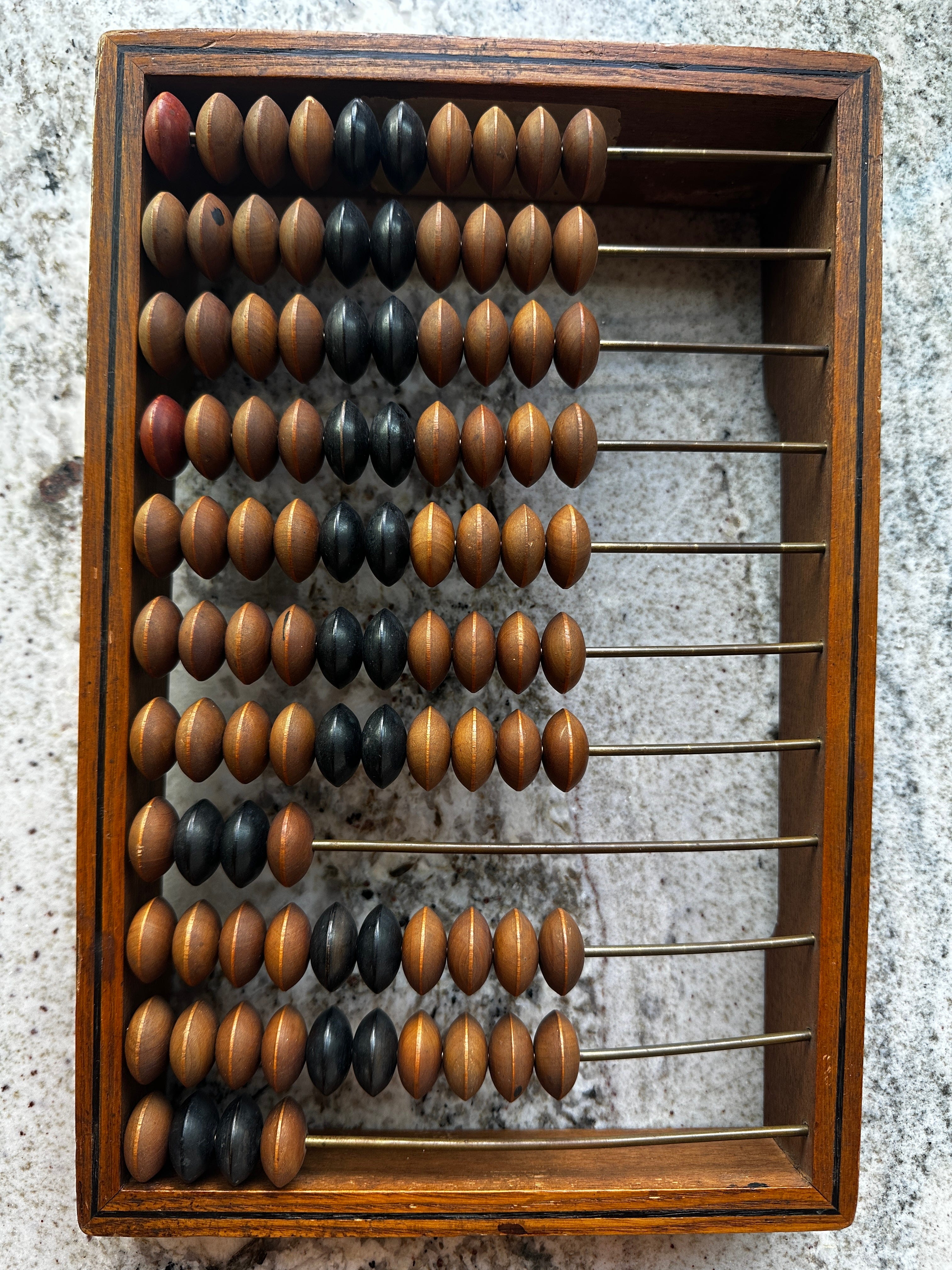
Russian schoty used in German schools, 1890s
It is a beautiful object, both physically and mathematically. Ignoring the bottom four rows for now, the top 7 encode base 10 numbers up to the millions, with ones at the bottom, tens above that, and so on. You slide beads to the right to represent a digit. Here is 1729, one of my favorite numbers.
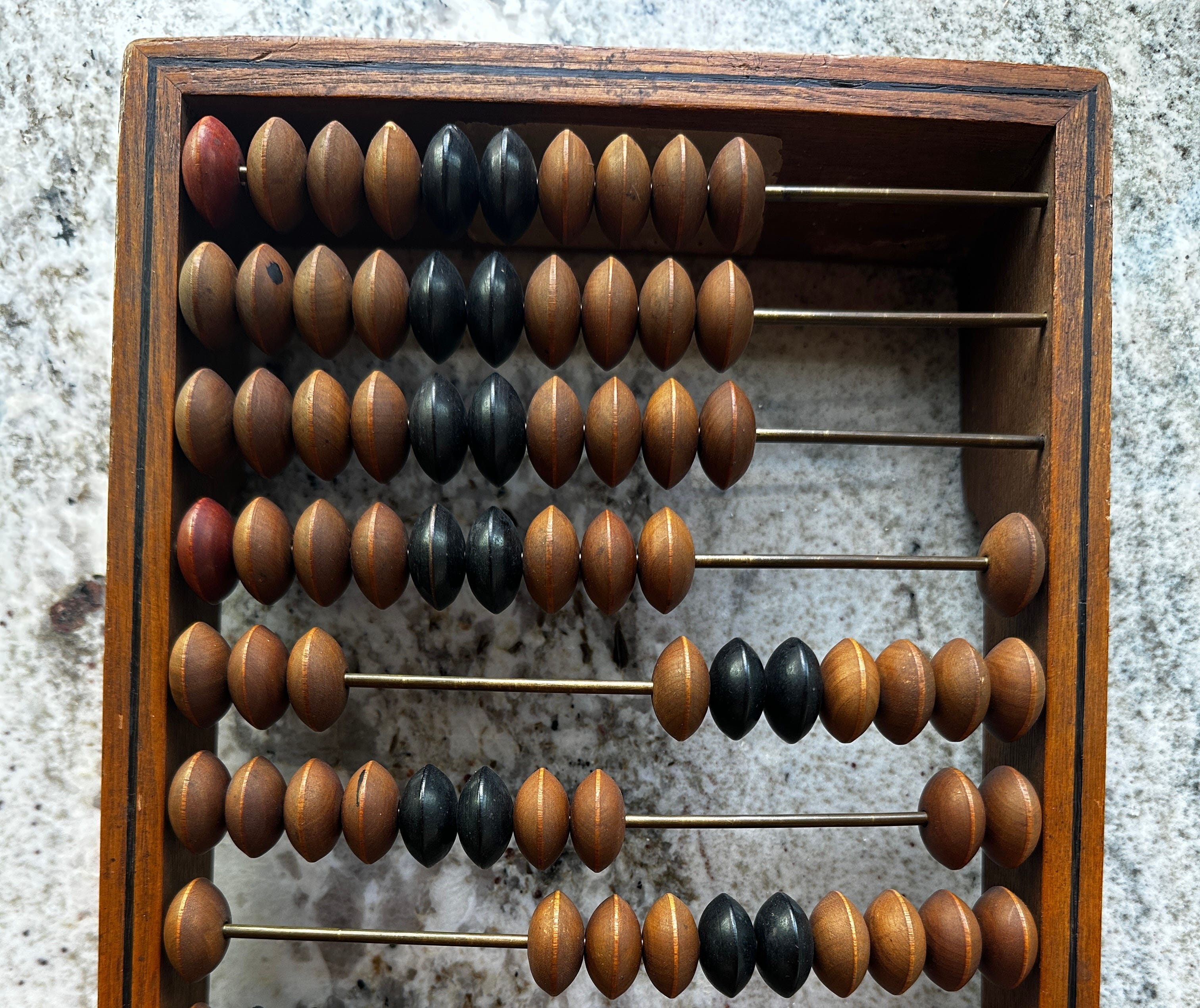
The different colored beads in the middle make it easy to see the 7 as a 5 and a 2. The 9 is visibly 1 less than 10. I imagine that for an adept user each pattern is instantly associated with a number, the way a written digit is for me.
You add two numbers by entering the first one and sliding beads across for the second. Here is me adding 8 + 5.
The action here is an exact analogue of the mental process I described in my previous post, and in this case the abacus forced it on me. There were only 2 beads left in the ones row, so adding the 5 broke into two steps. First move the 2 beads, then trade 10 ones beads for 1 tens bead, then add the remaining 3. The break-apart-and-make-ten strategy is a law of nature in the base ten ecosystem.
Here is a more complicated addition, 1729 + 1992.
I had to perform the place value trade 3 times. I was a little bit slow because I had to think about the decomposition of the digit I was adding each time, in order to remember how many beads to move across after the trade. But I imagine that with practice each of these motions would become automatic and rapid, the way 8 + 5 = 13 is for me. These motions are addition facts made tactile.1
If I get tired of moving beads around I can write down the addition this way,
using a superscripted 1 to indicate the one bead added in the higher row every time I slide 10 back to the resting position in the lower row.
We have discovered the standard algorithm! Every carried 1 corresponds to the action of moving a bead to the right in the row above the row where the addition is happening, which is why it superscripted on the column to the left. Discovered is the right word here, not invented. The algorithm was already there, inherent in the structure of the base ten system. That act of carrying the one, which can seem so arbitrary to students, is merely the record of the bead replacement transaction.2
You can see why this was used in German schools. If your goal is to not only teach students the addition algorithm, but to reveal its underlying structure in the base ten system, the abacus is a perfect tool.
The schoty was brought from Russia to Europe by the French mathematician Poncelet, who did foundational work in projective geometry while imprisoned in Russia during Napoleon’s 1812 Russian campaign. He gave it to a local teacher, suggesting it might be useful for teaching young children. It arrived just at the right time to spread throughout European schools through the ideas of the influential Swiss educator Johann Heinrich Pestalozzi (1746–1827), who believed that children learn through direct sensory experience and activity—through things, not just words.
I’ll leave you with the puzzle of those rows of four beads. What are they for? Why are they placed where they are? I don’t know for sure but I have a theory. What’s yours? Let me know in the comments.
There is a more efficient action that gives the same result: first move a tens bead to the right and then subtract 5 from the 8 in the ones row. This is equivalent to adding 10 and subtracting 5, which of course has the same result as adding 5. I imagine having a whole repertoire of such actions in muscle memory—the abacus equivalent of automatic recall of math facts.
The activity of adding on the abacus also makes clear why the standard algorithm goes from right to left, or rather, from lower denomination places to higher. If you went the other way you’d never be sure of having nailed down the digit in the place you were working on. Try adding 342 to 658 from left to right to see what I mean.
At first I thought it was the camera angle, but then I realized that the wires are actually bent, is that right, Bill? That is a beautiful little piece of engineering to keep those beads on the side you want them to be on.
As for the rows on the bottom... is it related to a calendar? weeks and days...? Thinking about 4 weeks per (lunar-ish) month... but still two rows of 10, but... that also equals 28 beads total on the bottom. Not sure!