
Beautiful expressions
This post brought to you by the letter x

I had planned to continue my math ed article series this week, but I need a breather from the footnotes, and I suspect some of you do too. So I want to go back to an issue I brought up a few weeks ago in Parlez-vous Algebra? There I argued that many algebra students experience expressions the way I experienced the French insurance office: as a stream of stuff they are supposed to do something with, without any firm conviction that the stuff means anything. I’ve been thinking about that post ever since, and about one letter in particular.
At some point x decided to leave the boring life of the algebra classroom and went out into the world in search of fame and fortune. It didn’t just want to be unknown, it wanted to be mysterious. And it wanted to be capitalized. Madame X. X marks the spot. The X-Files. And it became an icon for algebra as a mark of seriousness. If you want to sound technically sophisticated and strategic in a business meeting, you talk about “solving for X.”1
None of this would matter if x behaved itself back home in the algebra classroom. But it doesn’t. Sure, some problems might give it a meaning—“let x be the number of apples”—but the meaning is thin, worn briefly at the start of the problem and shed the moment the manipulation begins. It is the bare equation problem I wrote about in Parlez-vous Algebra?. By the time students are a few lines in, x is just sitting on the page waiting to be solved for. It is not a number, or a quantity, or a count of anything in particular. It is a small italic shrug. And then we ask students to manipulate it, and are surprised when they move it around like a sticker without regard for operations or parentheses.
Here is an expression in which no letter is allowed to shrug:
This is the beautiful expression for compound interest. Its beauty comes not from glamor, but from the work it does. Every letter is famous, but its fame is earned; each has a job, and you can read the job from the first letter, a convention that rewards you for paying attention.
P is the principal, standing proudly and multiplicatively out the front. r is the annual interest rate, augmenting the principal faithfully every year for t years. n appears twice in a balanced way, saying, “apply the interest n times a year but only one n-th at a time.” Then 1 + r/n is the factor you multiply your balance by at the end of one period: you keep what you had (the 1) and add a little bit more (the r/n). You do that nt times over t years, because there are n periods per year. Here parentheses and exponential notation are called into duty to describe the repeated multiplication. And then you multiply the whole repeated-multiplication-by-one-plus-r-over-n business by P, because whatever happens to a dollar in this account happens proportionally to P dollars.
You can read that expression like a paragraph, as I just did. Every letter is carrying a small piece of a story about a bank and a year and some money.
This is the experience I want students to have with algebraic expressions in general: not a collection of symbols they need to rearrange, but a phrase in a language, written by someone who meant something by it. Sometimes the meaning is a bank account. Sometimes it is the area of a rectangle, or the time it takes a ball to fall, or the number of handshakes in a room. The expression is not the mystery; the expression is the answer to the mystery, written down so you can read it later.
Poor x was not always a shrug. When Descartes introduced it in La Géométrie in 1637—the appendix to the Discourse on the Method that invented much of the notation we still use—he gave x a specific job as a variable, along with y and z, standing in honest partnership with the constants a, b, c, . . . at the other end of the alphabet.
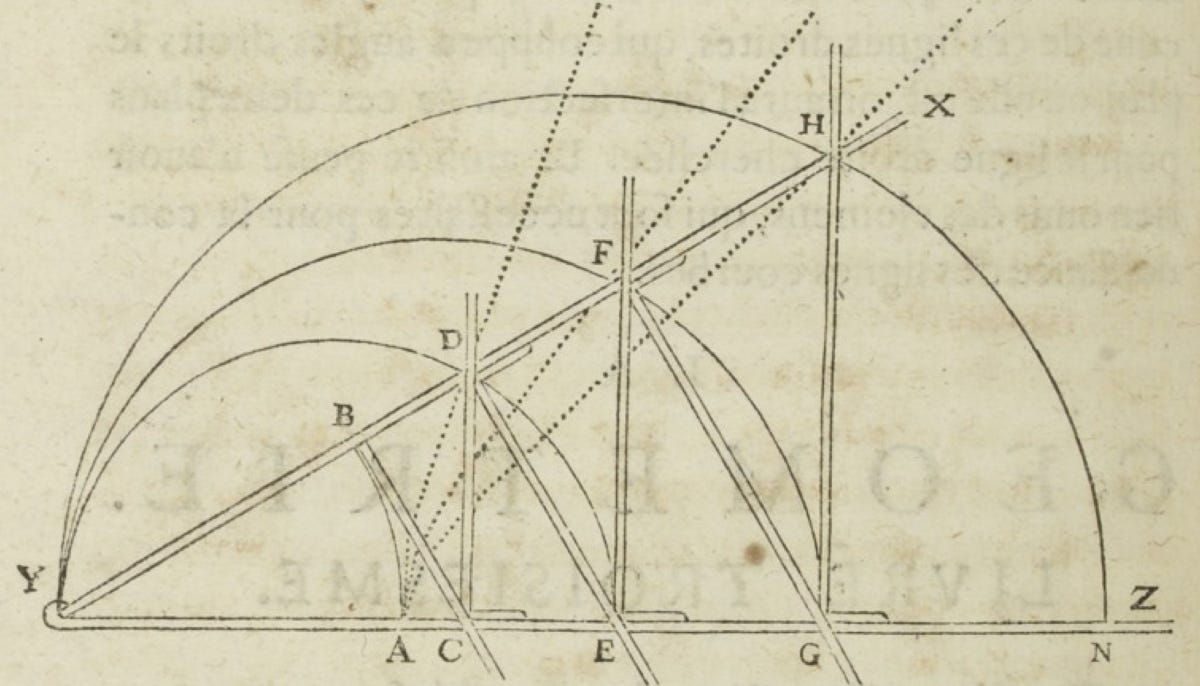
That is a respectable line of work. I would like to see x find meaning in that work again, next to P and r and n and t, and all the other letters that show up to an expression with something to say.
On Friday I want to talk about when technology enters the scene, starting with the appearance of graphing calculators in the classroom over 30 years ago, and musing on what happens when a beautiful expression meets a button that says ENTER. A famous mysterious number appears, and so do dangers. See you then.
P.S. If you are interested in the mathematics behind that image from Descartes, take a look at this article from the Mathematical Association of America.
I'll make an exception to the footnote ban for this Sesame Street episode brought to you by the letter x, at the 2:30 mark.
When I taught a 100-level math class last semester where the compound interest formulas were a big part of the course material, we started with understanding plain old r^x, then moved into a*r^x (now with a starting point), then a*(1+r)^x (now with a percent ratio/multiplier where >1 grows the values and <1 shrinks them), then a*(1+r)^xt (now with a multiplier for converting time units), and finally, a*(1+r/t)^xt (now with a divider to convert the APR to some other time unit).
When students viewed the compound interest formula as a special case of the more general exponential functions (repeated multiplication with a starting point), it was a lot easier to use the formula correctly and to make intelligent changes to make things easier.
Interestingly, most of my students really loved this, but I would say maybe 1/6 absolutely hated the in-depth discussion about how the algebra works and found little value in it, even if they understood it. When I asked why they didn't like it, every one of these students replied that they would rather just plug the numbers in from the formula because it's easier that way.
This was such a great read to start my morning ; it got all the neurons firing. Thanks, Dr McCallum