
Parlez-vous Algebra?
In which I reveal the point of my previous post

Encountering the reality of algebraic experience1
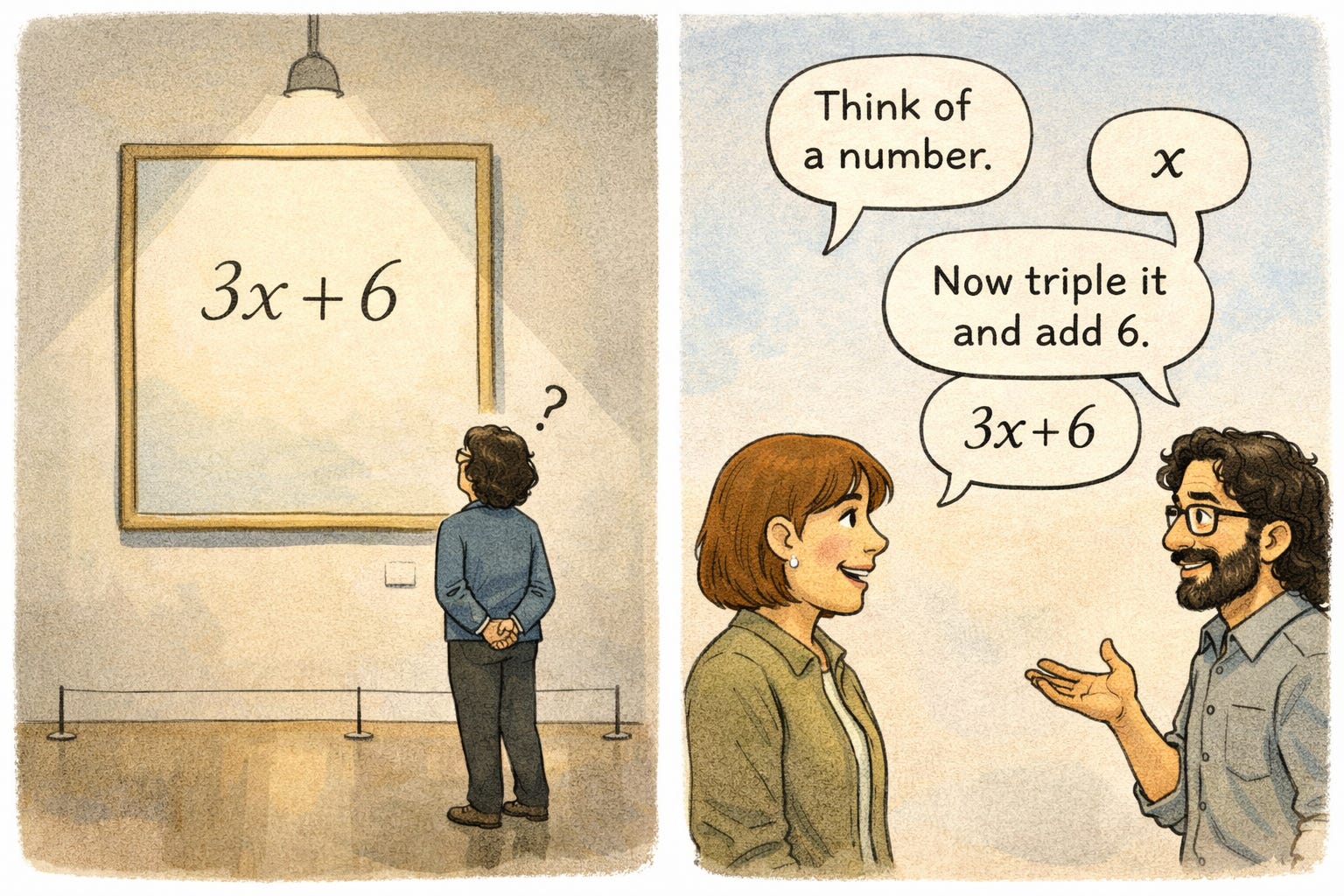
In my last post I told two stories of my encounters with the French language: one about trying to buy car insurance without understanding half of what was said, but managing to pick the right answer often enough to get through; the other about battling teachers at the local French school to get my daughter into the right class, and really needing to understand and be understood.2
Expressions as abstract art
I think that students in algebra are often in the car insurance situation. They find themselves in a linguistic fog. They’re getting by — answering questions, following procedures, passing tests — without understanding much of what’s going on. They might be doing perfectly fine and then, one day, they simplify (x + y)² as x² + y², and the teacher wonders what happened. From the teacher’s point of view they seemed to be doing alright (just as the insurance agent probably conducted the whole transaction in blissful ignorance of my incomprehension). This disconnect is illustrated beautifully in a video on Dan Meyer’s substack, where a teacher is trying to get students to translate “6 less than a number” into an algebraic expression. One student says 6 − n, perhaps just following the word order in the teacher’s prompt, another says n − 6, correctly but a little uncertainly.
There is a crucial difference between French and algebra, however. When I was in that insurance office, I never doubted that the French meant something — I just couldn’t always follow what it was. Many algebra students don’t even have that. When I look at an algebraic expression I see a language object — a phrase or sentence expressing meaning. I think that students often see expressions as something different. Possibly as pictorial objects, like puzzling pieces of abstract art. Or possibly as something that needs to be poked at and prodded until it gets into the shape the teacher wants. But the idea of looking at it for meaning, of asking what operations it is describing, what it is telling you about a sequence of operations with numbers, is not always there.
There’s evidence for this in the language we use. We teach students to “cross-multiply,” “cancel from top and bottom,” “move things across the equals sign” — all spatial metaphors, about position on the page, not about what the symbols mean. And FOIL is the worst offender: First, Outer, Inner, Last is entirely about where things sit, with zero mathematical content. You could explain this to readers without asking them to do any math — it’s about the positions of the symbols, not the algebra itself.
Expressions as meaningful language
There is a great debate in mathematics education which takes many forms: procedure versus understanding, drill versus exploration, direct instruction versus discovery learning. I think these are simultaneously useful distinctions and false dichotomies,3 and I’ll take them up in future posts. Here I want to concentrate on a necessary condition for all approaches. The argument between “drill the rules” and “teach for understanding” is less important than whether students approach algebra as something that has meaning in the first place. Different approaches can work if that belief is there. None work if it isn’t. My car insurance story is an example of rules before understanding; my school story is an example of understanding then figuring out the rules. It worked out fine in both cases because I knew that French was a real language that conveyed real meaning.
If algebra is approached as a subject that makes sense, then students can make progress, even if they don’t quite understand it right now. Nothing will work if instead they see algebraic expressions as essentially meaningless objects. If a variable arrives empty of purpose, not functioning as “a number whose identity I don’t know yet” or “any number I might want to test this with,” then you have already lost the game.
What is to be done?
I have thoughts about this which I might elaborate in a future post, but first I want to know what you think should be done, in the classroom, with real students. What have you tried that works, or doesn’t work?
To make this question crisper, let me give you an example of what I am looking for. Consider solving the equation 3x + 6 = 8:
A bare equation by itself has no meaning; it has to be clothed in words. The same applies to a bare list of equations. Here is the same solution, clothed:
If x is a number such that 3x + 6 = 8, then 3x = 2, because if two numbers are equal, then the results of subtracting 6 from them are also equal. If 3x = 2, then x = 2/3, because if two numbers are equal, then the results of dividing them both by 3 are also equal.
Notice that every step is justified by a statement about numbers, not about positions on the page. You don’t “move the 6 to the other side” — you subtract 6 from two equal numbers. You don’t “divide across” — you divide two equal numbers by 3. It’s just as easy to say “subtract 6 from both sides” as to say “move the 6 to the other side.” The first is about math, the second is about pictures.
To be clear, I am not suggesting that a teacher or student should say all these words every time they solve an equation. However, I am suggesting that teaching strategies should endeavor to bring about a state of mind in students where there is mathematically meaningful clothing, at least implicitly.4 I am reminded of what I said in my post about 8 + 5 = 13:
I am incapable of thinking of that addition fact without something else flashing through my head. It’s a very rapid decomposition of 5 into 2 + 3, plus a recombination of 8 and 2 into 10, plus a final addition of 3 to get 13.
I’d like the same sort of thing to happen when students solve equations. There should be a similar flow of mathematical reasoning, monitoring for the operations being conducted rather than for the symbols being moved.5
I’d love to hear your ideas on how we can make algebra more meaningful for students. How do we help them see the clothing of words, not the abstract positioning of symbols? Please let me know in the comments.
“I go to encounter for the millionth time the reality of experience and to forge in the smithy of my soul the uncreated conscience of my race.” James Joyce, Portrait of the artist as a young man. I’ve always thought that “forge in the smithy of my soul” was a particularly poetic description of constructivism.
I learned later that parents arguing with teachers is very much not done in France. Once I wandered into the school to pick up my daughter and was told I could wait outside the gate with all the other parents. I was like, “Oh, that’s what that crowd of people was.”
Direct instruction versus discovery learning is not so much a dichotomy as two ends of a spectrum, with the loudest voices at each end.
Jim Madden’s comment on my Wednesday post is relevant here: “a “fundamental principle of all communication [is to] understand that you’re trying to affect another agent.” [My emphasis.] My desire to have students think mathematically rather than pictorially while solving equations has consequences for how I communicate with them.
The principle of using mathematical language over position language applies elsewhere. When we tell students to “cancel 6 from top and bottom,” the word “cancel” has some mathematical meaning here — multiplying by 6 cancels multiplying by 1/6 in a meaningful sense. But the words “top” and “bottom” are strictly positional, and don’t make sense when students start seeing fractions written horizontally. The words “numerator” and “denominator” are more future-proof, and will come in handy when students start seeing algebraic expressions with nested numerators and denominators.
This post reminds of my own experience with high school. I always excelled in English classes. I loved reading and writing. Freshman year, Algebra was very challenging for me because it didn't make any sense for all the reasons you listed in your post. Sophomore year, I discovered that I really liked Geometry and did well in it! I liked writing 2 column proofs! I was also perplexed about how I could have 2 completely different experiences with math classes. Now I realize that Geometry had many more opportunities for me to communicate my sense making in words and images, which helped me make sense of the symbols. I am also reminded of my husband using Duolingo to learn Spanish. He has been using it for years- every night he practices. I am usually near him when he is practicing and find myself yelling out random words when I recognize them. I might say, "'grandma!' It is something about a grandma". I wonder, what conditions are necessary to create a similar experience for students when they see an expression like 3x + 6.
Valuable discussion about the language of mathematics. Thank you.
Your story set three thoughts whirling in my mind:
1. What does an expression “mean”? In school mathematics, an expression refers to a number. In this first level of referential meaning, numbers are the domain of what expressions mean. It would be quite fruitful if teachers and students brought this out in working with expressions. They are noun phrases referring to a number. What’s true of numbers is true of expressions.
But, as Jim Madden reminds us (pace Frege), reference is only the ground floor of meaning. Communication is between agents which brings purpose into the picture. We need to know something about purpose to make SENSE of the expression. Doesn’t need to be ‘authentic’ or ‘real world’…we could be just talking about numbers. We could be talking about worldly quantities as well. See 2.
2. Language learners need experience PRODUCING language to accomplish a purpose. In both your French situations you had to produce French. In one case fill in the blanks of a highly constrained transaction and in the other convey an argument to persuade an agent.
Malcolm Swan did a lot of work designing tasks for students to formulate expressions and equations. These were empirically designed working with real typical students and teachers. In general, I think asking students to formulate expressions and equations is not getting enough attention. Modeling, especially small episodes of modeling are needed. To get attention away from executing the calculation expressed by the model, give students the answer in advance and ask for the equation or expression.
3. The properties of operations and equality ( and a very few more laws and properties) are the complete syntax of school mathematics. Learning language requires absorbing the syntax. Purpose and agency are at the center of learning syntax. We fail to teach the properties as a system that works as a whole. In your short clothed example, multiple properties work together…as is usually the case. They are not just steps or moves, they define the language. We need more attention on the equivalence of expressions; they refer to the same number and thus have the same first level meaning. And, in interesting distinction, the equivalence of equations; they have the same value(s) of x that makes them true. This brings out the linguistic fact that equations are sentences, statements . Statements, unlike mere noun phrases, can be true or false or true under certain conditions. Solving an equation can be thought of as determine under what conditions the statement of equality is true. The truth of a statement is fundamental to its meaning.
One thing equivalence of equations has in common with equivalence of expressions is the equivalence of meaning.
This linguistic perspective on what expressions refer to, the truth of equations as statements and equivalence of meaning