
Connections and coherence
Where's the math?

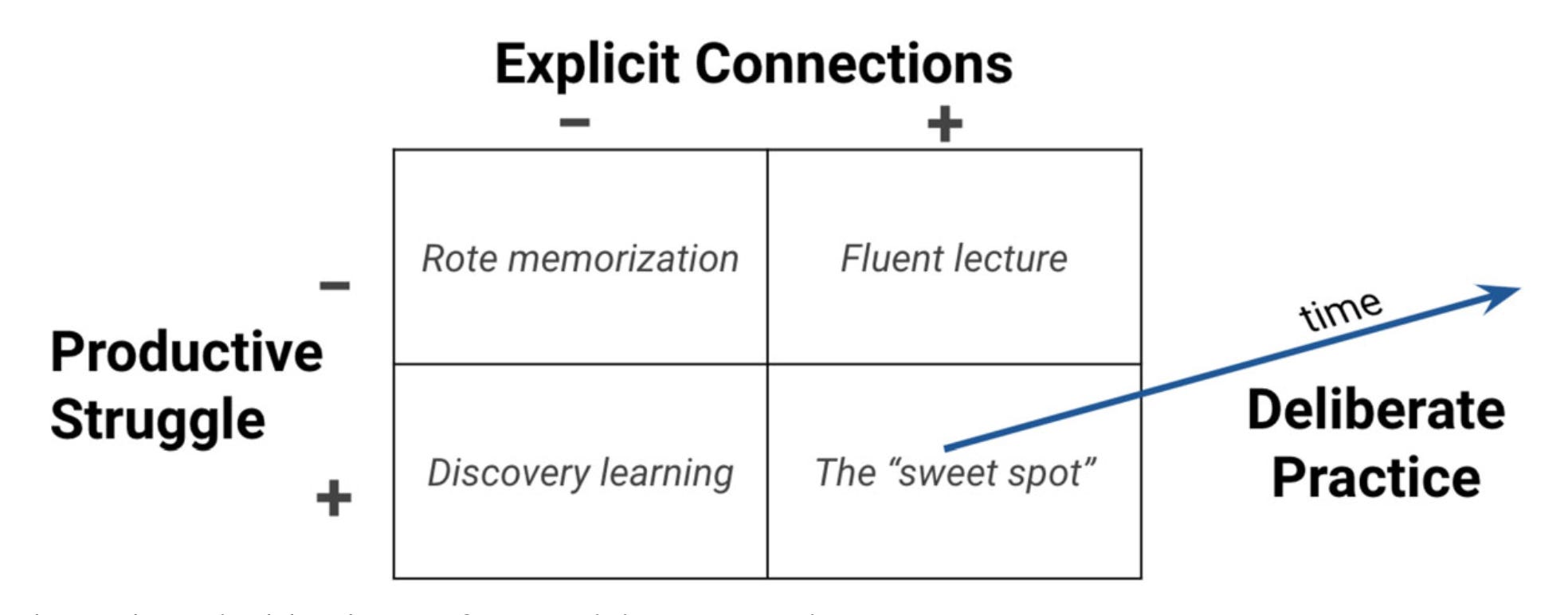
On Wednesday I asked how we can support a cultural script that keeps connection-making alive in math lessons. Why do I care so much about connections? First, mathematics is a uniquely connected subject. Everything is connected to what came before: counting numbers, fractions, rational numbers, and real numbers form one coherent number system, each one an augmentation of what came before. If, for example, students don’t see the connection between whole numbers and fractions through the number line, fractions appear to be some strange new beast with special rules for addition and subtraction. Second, the objects of study in mathematics are uniquely abstract—making them real is difficult, and making connections between different representations of them is one way to help. For example, functions become real once you see formulas, graphs, and tables as connected representations of the same thing. The different forms of an equation for a straight line become connected through the underlying concept of slope, so that you don’t have to memorize every form as a separate bit of information.
These examples illustrate that connections happen over time, in a well designed sequence of lessons. Making connections is not just a matter of what you do in an individual lesson—it is an aspect of coherent curriculum design. So I was intrigued by the time arrow in the diagram above that Jim Stigler sent me when he read my post on guided discovery a month ago, along with a paper, Practicing Connections: A Framework to Guide Instructional Design for Developing Understanding in Complex Domains, by Fries, Son, Givvin & Stigler. I love this diagram for many reasons. First, I love that it is two-dimensional, unlike so many arguments about pedagogy that try to fit everything on a one-dimensional spectrum. I love that the sweet spot is a convergence between Pr*d*ct*ve Str*ggl*1 and Explicit Connections. I love that it is in fact three-dimensional because it has that time arrow for Deliberate Practice, indicating that connection-making happens over time.
The practicing connections framework
Fries et al. describe a framework for curriculum design in relation to a statistics course the authors have developed, CourseKata. They argue that expert understanding in a complex domain is characterized by coherent, connected mental representations—schemas, in the cognitive-science literature—and that instruction should aim to help students build those. Three kinds of connections matter: connections to the world (contexts and practices the domain applies to), to core concepts that organize the domain, and to key representations used to think and communicate. Three principles guide instruction: make connections explicit, engage students in productive struggle, and give repeated opportunities to practice over time.
For their statistics course they chose as key representations verbal descriptions, visualizations, word equations, GLM (general linear model) notation, and R code. They add, “note that we did not choose algebra, in the form of formulas and equations, as one of our key representations, even though it is emphasized in most textbooks. Our reason for this is that our students do not typically find algebra to be readily accessible or useful, a consequence, we surmise, of K-12 mathematics education in the USA.”2
I’m not enough of an expert in cognitive science to judge whether the schema research that underlies this framework is the right synthesis of the evidence, and I’m not going to try. My main point here is that this is an example of what it looks like to pay careful attention to curriculum design and base it on an articulated instructional model.
Most of the pedagogical advocacy that I have been reading stops well short of this. It trades in Research-Based™ slogans and gets into futile chicken and egg arguments. The CourseKata folks have named the research, named the instructional principles, and built a curriculum that tries to follow them. You can check their work.
Subject-specific instructional design
The sweet spot in the diagram describes a single moment of instruction; the deliberate-practice arrow turns it into curriculum design—understanding developing over weeks and months of repeated connection-making at rising difficulty. What the paper doesn’t give you, and doesn’t really claim to give you, is what a teacher does in the room on Tuesday. The curriculum presumably supplies that.
But there’s something else worth noticing. The framework’s design choices are subject-specific. The connections and representations they chose, and the ones they decided to leave out, came from careful thinking about the structure of statistics—and that’s exactly where the curriculum work has to happen.
So I see three layers at work in any instructional design: (a) a pedagogical approach—the underlying view of how learning happens; (b) design principles for the subject—how the approach is operationalized in this domain; and (c) a lesson-level structure—what a teacher actually does in the room. The Fries et al. paper is strong on (a) and (b) and gestures at (c).
What I find missing from the current explicit-instruction trend isn’t the lesson-level layer—Rosenshine’s Principles of Instruction3 is vivid and widely distributed. What’s missing is the mathematics. The advocacy names the research behind explicit instruction and what a lesson should look like, but not how to graft those onto the structure of mathematics: what the important representations are, how to sequence them, how to make connections across topics, how the story of mathematics evolves over a unit or a year. The mathematics sits in the background, supposedly a known quantity. Whether this was also true of Engelmann’s Theory of Instruction—the direct-instruction tradition this trend descends from, about six decades old now—I don’t know; I haven’t studied it.
The reform tradition did take the mathematics seriously. NCTM’s Principles and Standards articulated a vision, not without contestation from mathematicians, and subsequent efforts at synthesis of the two sides followed, such as Cuoco et al.’s Habits of Mind and the Common Core. We built the Common Core on progressions precisely because we wanted to pay attention to the structure of the subject: articulating how the number system develops from whole numbers through fractions to rational numbers, how multiplication and division relate, how the properties of operations in arithmetic are a rehearsal for algebra. The reform curricula and their cousins of the 1990s and 2000s—Investigations, Connected Mathematics, Everyday Mathematics, IMP, CPM, Core-Plus, EDC’s CME Project, Math Expressions, and others—built curricula on such visions, with varying levels of explicitness about pedagogical and lesson-level design.
The point isn’t that all three layers must be written up as theory—that’s an academic exercise, not a curriculum-design imperative. The point is that all three are at work in any curriculum, and the test for any pedagogical recommendation is whether the work behind it has thought through all three. Especially, in mathematics, the middle one—is mathematics just a collection of bits and pieces, or is it a coherent whole about which the curriculum is telling a story?
Changing the cultural script
I remember in the reform era going to so many presentations that said, in effect, teachers have to change everything they are doing right now. That’s not how culture change works. Exhortation doesn’t change a script—the pressure to fall back on procedural walkthroughs is structural. Not even materials can, but they can help. One way we can support teachers is to provide them with materials that have all three layers articulated and connected. Frameworks operating at all three levels are partial answers because they can shape materials, can shape sequences across years, and can give teachers something to work from beyond exhortation. And a good design framework extends beyond curriculum materials to professional learning and supplemental products.
The argument worth having about teaching mathematics isn’t whether to model procedures or guide discovery. It’s whether the work behind your position connects all three layers—view of learning, subject-specific design principles, lesson-level practice. Focusing on the mathematics causes you to focus on finding the right tool for the specific topic at hand, be it ratios or completing the square, and recognizing that different tools do different work. That’s where common ground lies.
Unfortunately this term has fallen victim to the M*th W*rs. I have decided to start calling it doggedness.
Ouch. Guess I’ll spend the rest of my life gardening.
I’ll get around to writing about those one of these days.
Shout out IMP. Best years of my teaching career. Part (c) was the most difficult part for teachers. Starting with knee-jerk reactions to the perceived lack of deliberate practice, and ending with too much proceduralizing.
Yay! You emphasize that it is super important to keep mathematics in math teaching. Dr Valeriy Manokhin (https://valeman.medium.com/how-many-children-learned-mathematics-from-kiselevs-textbooks-ff4efceade0d) makes the same point about A.P. Kiselev’s arithmetic book used from the 1880s to the 1970s in Russia and the Soviet Union.